7 July 2026
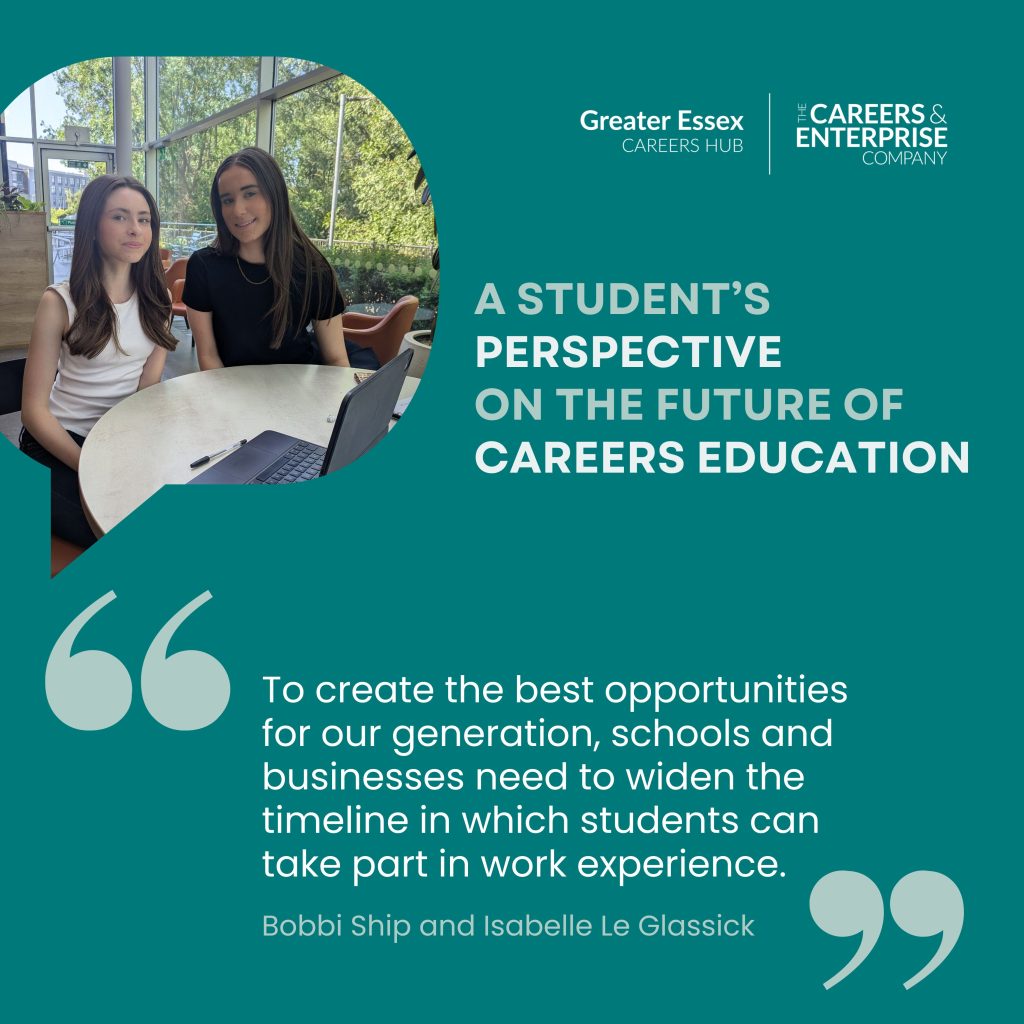
‘A Student Perspective on the Future of Careers Education’ by Bobbi Ship and Isabelle Le Glassick
About the Authors
This report has been written by Bobbi Ship and Isabelle Le Glassick, Year 12 students at Saffron Walden County High School, who joined the Greater Essex Careers Hub for a work experience placement during our end-of-year conference, Let’s Make It Work. As students preparing for their own future career journeys, Bobbi and Isabelle attended the event to hear directly from employers, educators and industry leaders, and to share their reflections on the discussions around work experience, inclusion and careers education. Their article offers a valuable student perspective on how schools and businesses can work together to create meaningful opportunities for young people.
The Greater Essex Careers Hub Conference is an event that explores the future prospects for young people and how schools and businesses can help enhance their perspectives on employment through the improvements of work experience. This topic is crucial to address when confronting the issues young people face when entering the work environment, such as lack of preparation, experience and knowledge of broad ranging opportunities. The event attempts to inspire, prepare and proceed to support the next steps of new generations.
Work Experience Insight:
As Louise Warren, from Epping District Council, outlined an essential to work experience is “remembering its about the students”. However, it is evident that when it comes to arranging placements, there is a lot to consider from each party involved, sometimes leading to a disengaged and poorly planned position that does not benefit the student or the business. The WEX Pilot Panel offered a vast range of modernised advice that can guide both employers and students to communicate important details that ensure the work experience opportunity will allow students to reach their full potential whilst businesses expand their perspectives on the upcoming youth of today’s society. Multiple attendees highlighted the importance of communication skills when entering the world of work. The Panels response to combatting lack of confidence within teenagers is for schools to prioritise student involvement in work experience from KS3 rather than in Year 10 or 11, limiting the range of industries they cover. Kate Green, NHS Essex Healthcare Academy Manager, found younger students were more enthusiastic and hands on with the activities proving beneficial for the students. The “biggest and highest qualification a business can give a student is confidence” and it is evident that this is successfully done through starting placements in younger years and following up these placement each school year building confidence through repetition.
Inclusion:
The working environment is full of stereotypes surrounding individualities that need to be broken down to avoid students believing that they will not succeed in certain industries, due to their genders, disabilities, or any other minorities. Work Experience is a great opportunity for both students to discover that they are entitled to make any employer aware of their situation and for businesses to unravel certain stereotypes surrounding their field. Inclusion can be tackled in many different ways when helping students to help find a placement suitable for them, for example, schools can allow students to apply for work experience outside of the regular block placements and instead complete the placement in smaller segments over a longer period of time. The importance of inclusion is evident when students like Matt Coffey’s, from The FitzWimarc School, can see people alike them in industries they never thought would be open for them, signifying how detrimental it is for students to observe work spaces they would’ve never considered before.
Student Perspective:
From the perspective of two current Sixth-Form Students, we found it intriguing to listen to the opposite point of view coming from businesses owners and teachers to see how they navigate placements, as well as their individual opinions on how they think this area can be improved. We agree that to create the best opportunities for our generation, schools and businesses need to widen the timeline in which students can take part in their placements to broaden their scope of different industries. Also, from a business point of view, we believe that the relationship between employers and students/ teachers should be improved, in order to keep students aware of further opportunities in the field their placements are based in, and to receive vital feedback to help them progress. Overall we think the work Greater Essex Careers Hub are doing to implicate these improvements is a huge step forward into helping youth choose the right paths for their future and succeed in taking the right steps to achieve their goals.
Conclusion:
To conclude, we want to reaffirm the key message that work experience needs to be adapted to support the changing skillset standards needed for the new generations. And through the work Greater Essex Career Hub are doing, we are confident these changes will be implemented all over the county.